
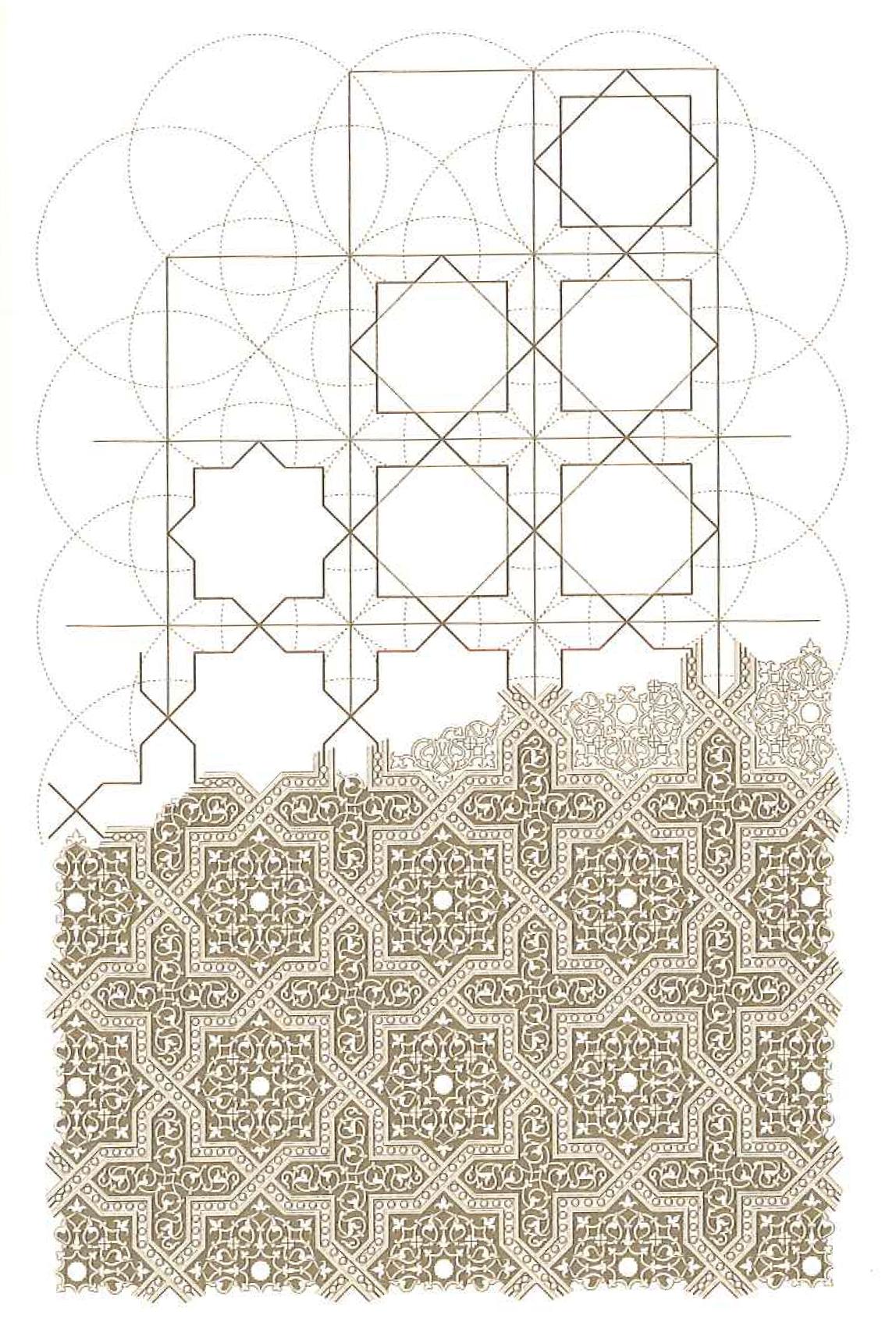
Tracing the Eight-Pointed Star Through Architecture, Mathematics, and the Decorative Arts
Look closely at an eight-pointed star, and something remarkable begins to happen.
What initially appears to be a simple decorative motif gradually reveals a much more complex structure. Lines intersect. Squares rotate. Smaller shapes emerge between larger ones. A single star becomes part of a network, and that network can continue almost indefinitely.
Across centuries, this deceptively simple geometry has appeared on the walls of mosques, the floors of palaces, ceramic tiles, carved wooden doors, illuminated manuscripts, woven textiles, and inlaid furniture.
Its visual language has travelled across continents, adapting to different materials, cultures, and artistic traditions.
The eight-pointed star is among the most recognisable forms in Islamic geometric ornament, but its history cannot be reduced to a single civilisation or moment of invention.
Its underlying geometry is older, its meanings have varied, and its development reveals an extraordinary relationship between mathematics and artistic imagination.
To understand this pattern is to discover how a few simple lines became one of the world's most enduring forms of decoration.
I. The Anatomy of an Eight-Pointed Star
Before exploring its history, it is worth understanding how the pattern works.
At its simplest, a regular eight-pointed star can be constructed by placing two identical squares over one another, rotating the second square by 45 degrees.
The overlapping forms create eight points arranged around a common centre.
This familiar figure is sometimes called an octagram, although the term covers more than one geometric construction.
The eight-pointed star seen in decorative arts is not always a perfect mathematical octagram. Artisans frequently adapt its proportions, extend its lines, or combine it with other polygons to create more elaborate compositions.
What matters is the underlying principle of eightfold organisation.
A full circle contains 360 degrees. Dividing it into eight equal parts creates intervals of 45 degrees.
This gives the designer a system of radial relationships from which squares, octagons, stars, and interlacing lines can be developed.
The most interesting transformation occurs when the star is repeated.
A single eight-pointed star cannot cover an entire flat surface without gaps. But when combined with squares, crosses, or other connecting shapes, it can become part of a tessellation—a composition that covers a surface without unwanted gaps or overlaps.
The pattern ceases to be a collection of isolated stars.
It becomes a continuous geometric system.
This is the principle visible in many historical star-and-cross tile arrangements, where one shape creates the space required for another.
It is also the principle underlying the contemporary geometric composition illustrated here: repeated eightfold star forms, angular connections, and smaller intermediate motifs are organised into a continuous decorative field.
The beauty of such a design lies not only in the star itself, but in the relationships between its parts.
II. Before Islamic Geometry: The Ancient Origins of Repeated Pattern
The origins of geometric ornament extend far beyond any single architectural tradition.
Ancient civilisations developed sophisticated systems of repeated shapes long before the emergence of Islamic art in the seventh century.
Greek and Roman artisans employed geometric arrangements in floor mosaics, architectural borders, pottery, and decorative surfaces.
Squares, circles, triangles, and interlacing forms provided a vocabulary for constructing repeated compositions.
In the late antique world, the Byzantine and Sasanian empires developed particularly influential traditions of decorative geometry.
Sasanian Iran, which flourished from the third to the seventh century CE, produced textiles, metalwork, architectural decoration, and other objects featuring carefully organised ornamental arrangements.
These traditions became important sources for later Islamic decorative arts.
The development was not a simple transfer of finished designs from one civilisation to another.
Artists inherited shapes and techniques, adapted them to new materials, and developed increasingly complex arrangements.
The Metropolitan Museum of Art identifies Greek, Roman, Byzantine, and Sasanian traditions as important foundations for the geometric ornament that later became characteristic of Islamic art.
The distinction is essential.
Islamic artists did not invent geometry.
Their extraordinary contribution was to elevate geometric pattern into a major artistic language, developing systems of repetition and interconnection with a level of sophistication that became influential across a vast geographical region.
III. The Emergence of Islamic Geometric Ornament
From the seventh and eighth centuries onward, the expansion of Islamic civilisation brought together artistic traditions from the Mediterranean, the Middle East, Persia, Central Asia, and beyond.
Architecture and decorative arts developed through encounters between different cultures, materials, and techniques.
Geometric ornament became especially prominent alongside calligraphy and vegetal decoration.
These three visual traditions often appeared together, creating compositions in which written language, natural forms, and mathematical order complemented one another.
It is sometimes suggested that Islamic geometric ornament emerged simply because religious restrictions prohibited images of living beings.
The historical reality is more complicated.
Figural imagery existed in many Islamic artistic contexts, particularly in secular painting, ceramics, and courtly objects.
The preference for nonfigural decoration in many religious settings was important, but it was not the only reason geometry developed so extensively.
The intellectual traditions of mathematics, the technical knowledge of artisans, the availability of materials, and the desire to create distinctive architectural environments all contributed.
The Early Development of Star Patterns
By the ninth and tenth centuries, geometric motifs were becoming increasingly prominent in Islamic architecture.
The Great Mosque of Kairouan in present-day Tunisia and the Mosque of Ibn Tulun in Cairo belong to the early architectural contexts frequently discussed in histories of Islamic geometric ornament.
These buildings reveal the growing importance of repeated geometry in architectural decoration.
Over subsequent centuries, artisans developed more elaborate star arrangements, interlacing bands, and polygonal compositions.
The development was not uniform across regions.
Different workshops pursued different approaches, sometimes favouring relatively simple repetitions and sometimes producing extraordinarily intricate designs.
What emerged was not one universal pattern, but a family of related geometric systems.
The eight-pointed star became one of its most adaptable elements.
IV. Persia and the Art of the Star-and-Cross Tile
One of the most beautiful historical expressions of the eight-pointed star appeared in medieval Persian ceramics.
During the twelfth and thirteenth centuries, workshops in Iran produced architectural tiles in distinctive star and cross shapes.
The city of Kashan became particularly associated with sophisticated lustre-painted ceramics.
Lustre decoration involved applying metallic compounds to glazed ceramic surfaces and firing them under controlled conditions to produce a reflective, often golden or copper-coloured finish.
The result could appear almost metallic, although the surface was ceramic.
Eight-pointed star tiles were frequently combined with cross-shaped tiles to cover architectural surfaces.
The geometry was ingenious.
Rather than painting a repeated star pattern onto a rectangular tile, artisans shaped the ceramic pieces themselves into stars and crosses.
The decorative composition was therefore built into the physical structure of the wall covering.
A star was not merely an image.
It was an architectural component.
Surviving examples also reveal that geometric form did not exclude other kinds of ornament.
Some star tiles were decorated with floral imagery, animals, figures, inscriptions, or poetry.
A particularly revealing example is a thirteenth-century star-and-cross tile panel from Kashan preserved at the Metropolitan Museum of Art.
Its constituent tiles include inscriptions from religious and literary contexts, illustrating how similar geometric formats could serve different architectural purposes.
This is one of the most fascinating characteristics of the eight-pointed star.
Its structure is precise, but its decorative possibilities are remarkably open.
V. Girih: When Geometry Became an Art of Interlacing
As geometric ornament developed across Persia and neighbouring regions, artisans created increasingly sophisticated systems of interlacing lines.
One important tradition is known as girih, a Persian term associated with knots or interlaced geometric strapwork.
Girih designs often appear to consist of ribbons travelling across a surface, turning at carefully calculated angles and forming stars, polygons, and interconnected shapes.
The visual effect can be astonishing.
A viewer may follow one line across the composition, only to discover that it belongs to a much larger network.
Unlike a simple checkerboard, where the repeated unit is immediately obvious, complex girih designs can conceal their organising structure.
The eye moves continuously between local detail and overall order.
This is part of their enduring appeal.
The pattern rewards prolonged observation.
The Topkapi Scroll: A Rare Window into the Designer's Mind
One of the most important surviving documents for understanding historical geometric design is the Topkapi Scroll.
Preserved in the Topkapi Palace Museum in Istanbul, the scroll is generally dated to the late fifteenth or sixteenth century.
It contains architectural and ornamental drawings, including geometric compositions and designs associated with complex architectural forms.
Art historian Gülru Necipoğlu examined the scroll in her influential study The Topkapi Scroll: Geometry and Ornament in Islamic Architecture.
Its significance lies in what it reveals about design knowledge.
We often encounter historical ornament as a finished surface: a tiled wall, a carved door, or a patterned ceiling.
The scroll allows us to consider the intellectual work behind such objects.
It demonstrates that complex decorative compositions were not simply improvised by eye.
They could be planned, transmitted, studied, and adapted through geometric drawings.
The relationship between mathematicians, architects, and skilled artisans was especially important in the development of these traditions.
Geometry was both a practical method and a creative instrument.
VI. A Mathematical Discovery Hidden in Medieval Architecture
In 2007, physicists Peter J. Lu and Paul J. Steinhardt published a study in the journal Science examining medieval Islamic geometric patterns.
Their research suggested that some artisans had developed a sophisticated method of constructing girih designs using a set of decorated polygonal tiles.
Rather than drawing every line independently, designers could assemble larger patterns from predefined geometric units.
The researchers argued that this approach was in use by around 1200 CE.
They also identified an especially intriguing development in fifteenth-century architecture.
At the Darb-i Imam shrine in Isfahan, Iran, they found evidence of a pattern approaching quasiperiodic order.
Unlike an ordinary repeating pattern, a quasiperiodic arrangement can possess long-range mathematical organisation without repeating through a single simple translational unit.
The study compared aspects of the medieval design with mathematical ideas associated with Penrose tilings, which became famous in the twentieth century.
The research attracted considerable attention because it suggested that medieval artisans had explored highly sophisticated geometric structures centuries before their formal treatment in modern mathematics.
The interpretation has also generated scholarly discussion, particularly concerning how much mathematical understanding can be inferred from surviving patterns.
Nevertheless, the research reveals something extraordinary.
Historical decorative arts can preserve evidence of advanced spatial reasoning.
A patterned wall may be as intellectually interesting as it is visually beautiful.
It is important, however, not to confuse all geometric star patterns with quasiperiodic tilings.
The regular eight-pointed star-and-cross arrangements commonly seen in ceramics and furniture are generally periodic designs.
Their beauty does not depend on mathematical aperiodicity.
Instead, it lies in the elegant repetition of a carefully organised unit.
VII. From Persia to North Africa: Geometry in Zellij
Across North Africa, geometric ornament developed through distinctive regional traditions.
One of the most celebrated is Moroccan zellij, a form of mosaic tilework constructed from individually cut pieces of glazed ceramic.
Artisans shape the pieces into precise geometric forms and assemble them into elaborate compositions.
The finished patterns can include stars, polygons, interlocking bands, and repeating geometric networks.
Zellij is particularly associated with Moroccan architectural traditions, including those of Fez and Marrakesh.
The process requires an extraordinary understanding of both geometry and material.
Individual pieces must fit together accurately.
Small variations in angle or dimension can affect the continuity of the entire composition.
What appears to be a seamless surface is the result of many separate components brought into precise relationship.
This is a recurring theme in the history of geometric ornament.
Complexity is created through the disciplined assembly of simpler elements.
The visual effect of Moroccan geometric tilework is often intensified through colour.
Contrasting glazed surfaces allow the viewer to distinguish overlapping shapes, while repeated motifs establish rhythm across walls, fountains, courtyards, and architectural details.
The pattern becomes part of the spatial experience.
It changes with distance, light, and movement.
VIII. Al-Andalus: The Architecture of Repetition
In medieval Islamic Spain, geometric ornament developed into another extraordinary architectural tradition.
The Alhambra in Granada, largely associated with the Nasrid dynasty of the thirteenth to fifteenth centuries, is among the most celebrated surviving examples.
Its decorated interiors combine geometric tilework, carved stucco, inscriptions, vegetal ornament, and architectural forms.
What makes the Alhambra especially compelling is the relationship between decoration and space.
Geometric patterns cover walls and lower architectural surfaces, while carved ornament and calligraphy occupy other zones.
Courtyards, water, light, and repeated architectural elements contribute to the overall composition.
The effect is not simply one of decorative abundance.
It is an environment organised through multiple systems of rhythm and proportion.
The Alhambra has also attracted sustained mathematical interest because of the variety of symmetry relationships found in its ornament.
Its patterns demonstrate how a limited vocabulary of geometric transformations—rotation, reflection, translation, and repetition—can generate extraordinary visual diversity.
Although the Alhambra contains many kinds of geometric designs, not all are based on eight-pointed stars.
Its importance to this history lies in the broader development of geometric ornament as a sophisticated architectural language.
IX. The Eight-Pointed Star in the Indian Subcontinent
The geometric traditions of Persia and Central Asia influenced architecture and decorative arts across the Indian subcontinent, particularly through the Delhi Sultanate and Mughal periods.
These influences interacted with established Indian traditions of stone carving, architectural geometry, textile design, and ornament.
The resulting visual culture was neither a simple import nor a direct continuation of one earlier style.
It was shaped by exchange and adaptation.
Jali: Geometry Through Light and Shadow
One of the most distinctive expressions of geometric ornament in South Asian architecture is the jali, a perforated screen carved from stone or other materials.
Jali screens serve practical purposes.
They can filter sunlight, provide privacy, and allow air to pass through an opening.
But they are also remarkable decorative surfaces.
A jali transforms geometry into an interaction between solid material and empty space.
The carved portions establish one pattern.
The openings establish another.
As sunlight passes through the screen, its geometry is projected onto floors and walls.
The pattern effectively leaves the object and enters the surrounding architecture.
The Metropolitan Museum of Art preserves a sixteenth-century Mughal sandstone jali whose design incorporates eight-pointed stars within a more elaborate network of polygons.
The museum highlights the importance of positive and negative space in understanding its composition.
This offers a particularly beautiful interpretation of geometric ornament.
The design is not only what remains in the stone.
It is also what has been removed.
Geometry in Wood, Bone, and Ivory Inlay
The movement of geometric ornament into furniture and smaller decorative objects created new possibilities.
Unlike monumental architecture, furniture introduces questions of scale, handling, joinery, and everyday use.
An intricate pattern must adapt to drawers, doors, corners, edges, and structural divisions.
Historical inlaid woodwork demonstrates how artisans approached these challenges.
The Metropolitan Museum of Art records an Egyptian marquetry panel from the second half of the eighth century made with wood and bone.
Its collection also includes a late sixteenth- to early seventeenth-century writing box decorated using the sadeli technique, incorporating ebony, ivory, bone, and brass.
These objects illustrate the long history of geometric ornament in materials beyond stone and ceramic.
A pattern that occupies an architectural wall can also be translated into a relatively small object.
The geometry remains recognisable, but the experience changes.
Instead of being viewed from across a courtyard, the design can be encountered at arm's length.
The viewer becomes aware of material joins, surface textures, and the precision of individual components.
X. Understanding the Pattern: Star, Cross, and Repetition
The contemporary pattern considered here belongs to the broader visual tradition of eightfold geometric ornament.
Its most prominent elements are repeated star-like figures arranged within a rectilinear grid.
The stars are connected by angular bands, smaller geometric shapes, and intervening fields.
The composition also employs borders that frame the larger pattern.
Several aspects deserve closer examination.
The Star as a Visual Centre
Each eight-pointed figure creates a point of visual concentration.
The eye is naturally drawn towards the centre, where the surrounding geometry appears to converge.
This gives the design a rhythm of repeated focal points.
The Importance of the Spaces Between
The areas separating the stars are equally important.
These intermediate shapes allow the composition to continue without visual interruption.
In many historical star-and-cross arrangements, the connecting shapes are essential to the mathematical structure of the tessellation.
Without them, the stars would remain isolated motifs.
Positive and Negative Space
The contrast between light and dark areas allows different geometric forms to emerge.
A shape may appear prominent when viewed as a light figure against a dark ground.
Reverse the visual relationship, and a different pattern may become visible.
This interplay creates a sense of complexity without requiring an unlimited number of motifs.
The Border as a Frame
The smaller repeating elements along the edges establish a clear boundary.
Historically, geometric borders have often served to organise decorative fields and distinguish one visual zone from another.
In furniture, borders also help the pattern respond to the physical edges of the object.
They create a transition between the continuous geometric surface and the finite form of the cabinet or chest.
Colour Changes the Pattern's Character
The same geometry can produce strikingly different impressions depending on its colour relationships.
Soft green and ivory create a restrained, almost architectural quality.
Coral and ivory emphasise warmth and rhythm.
Black and ivory sharpen the contrast, making the geometry appear more graphic.
The mathematical structure remains broadly unchanged.
Yet the emotional and visual character of the design shifts.
This reveals the remarkable flexibility of geometric ornament.
A pattern developed through precise relationships can accommodate an almost unlimited range of material and colour interpretations.
XI. The Eight-Pointed Star and Its Many Meanings
Across different cultures, eight-pointed stars have acquired a variety of symbolic associations.
In ancient Mesopotamian visual traditions, an eight-pointed star could be associated with the goddess Inanna, later identified with Ishtar.
In Islamic contexts, eightfold forms have sometimes been interpreted through religious, cosmological, or philosophical ideas.
The Rub el Hizb symbol, formed from two overlapping squares, is another recognisable eight-pointed figure associated with Islamic manuscript and textual traditions.
However, these examples should not be treated as evidence that every eight-pointed star carries the same meaning.
Similar geometric forms can emerge independently.
Their significance depends on context, period, function, and the traditions of the people who made and used them.
A star-shaped ceramic tile in thirteenth-century Iran, a carved architectural screen in Mughal India, and a contemporary decorative surface may share a geometric structure without sharing an identical symbolic purpose.
This distinction matters because it allows us to appreciate both the continuity of form and the diversity of cultural meaning.
Geometry travels.
Meaning changes.
XII. The Art of Repetition
Why do repeated geometric patterns remain so compelling?
Part of the answer lies in the balance between predictability and discovery.
Once the eye recognises a repeating unit, it begins to anticipate the next.
There is a sense of order.
But complex geometric compositions also encourage the viewer to discover secondary shapes.
A star may reveal an octagon. Intersecting bands may create a square. Small spaces between larger motifs may form an entirely different network.
The viewer is continually moving between recognising the familiar and discovering something new.
This is particularly evident in patterns that can be extended beyond their visible boundaries.
A geometric surface may end at the edge of a wall or object, but the viewer understands that the underlying system could continue.
The physical surface is finite.
The geometric idea is potentially infinite.
Perhaps this is why such patterns possess an unusual sense of permanence.
They do not depend on representing a particular landscape, person, or historical event.
Their structure can be understood through relationships between lines and shapes.
And those relationships can be reinterpreted indefinitely.
XIII. The Pattern in Contemporary Design
Today, geometric star patterns continue to appear across architecture, textiles, ceramics, furniture, and graphic design.
Their survival is not simply the result of nostalgia.
They possess qualities that remain relevant to contemporary design.
They are adaptable to different scales.
They can be restrained or elaborate.
They can be expressed through contrasting colours or subtle changes in material.
And they allow traditional decorative knowledge to enter new contexts.
A pattern once assembled from glazed ceramic pieces can be interpreted through cut stone, carved timber, woven threads, metal, or inlaid surfaces.
Each material changes the way the geometry is experienced.
Ceramic emphasises colour and reflection.
Stone introduces permanence and mass.
Wood reveals grain and depth.
Inlay draws attention to the relationship between individual pieces and the surface that contains them.
The challenge for contemporary designers is not simply to reproduce historical ornament.
It is to understand its underlying principles.
Why do the shapes fit together?
How does repetition create rhythm?
What happens when the scale changes?
How do colour and material alter the composition?
These questions turn a historical motif into a living design language.
XIV. A Pattern Without an Ending
The history of the eight-pointed star is not the story of a single inventor.
It is the story of an idea developed and transformed by generations of artists, mathematicians, architects, and artisans.
Its geometry connects ancient traditions of repeated pattern with the remarkable achievements of medieval Islamic decorative arts.
Its history moves through Persian ceramics, North African mosaics, Andalusian architecture, Central Asian geometric systems, and the carved and inlaid surfaces of South Asia.
At every stage, the motif has been adapted to new materials, techniques, and cultural settings.
And yet the underlying relationships remain recognisable.
Two squares.
A rotation.
Eight points.
A series of lines that can be extended into a seemingly endless network.
What makes the pattern extraordinary is not simply its complexity.
It is the possibility of creating so much from so little.
A compass, a straightedge, and a few carefully considered relationships can generate a visual language capable of crossing centuries and continents.
The pattern does not belong exclusively to the past.
Each time it is redrawn, carved, woven, tiled, or inlaid, it becomes part of another moment in its history.
Perhaps that is the true beauty of geometric ornament: its forms are finite, but the possibilities they contain are not.
Share:
The Fabric of the Earth
The Art of Abundance