
A Cultural History of Ornament, Maximalism, and the Human Desire for Beauty*
There is something curious about the way we speak of maximalism today. We describe it as a return, a revival, or sometimes even a rebellion against the quiet restraint of modern interiors. Colour is returning to our walls. Patterned textiles are replacing plain upholstery. Rooms are once again filling with ceramics, paintings, inherited furniture, books, and objects collected over a lifetime.
But returning from where?
For much of human history, ornament was not an exception to the rules of design. It was an essential part of how people understood beauty, communicated identity, expressed devotion, and demonstrated skill.
A carved doorway could tell a story. A woven textile could identify a community. A painted ceiling could represent the heavens. Even an ordinary domestic object could carry symbols of protection, fertility, prosperity, or belonging.
What we now call maximalism belongs to this much longer history of human expression.
The word itself is relatively modern, and applying it to ancient civilisations is necessarily an interpretation. An Egyptian palace, a Mughal garden, and a Victorian drawing room were created within profoundly different social and cultural worlds. They cannot simply be grouped under a contemporary decorating label.
Yet they share a fascinating characteristic: an understanding that the spaces we inhabit can communicate far more than their practical function.
Perhaps the more interesting question is not why maximalism has returned, but why we ever came to believe that ornament was something we needed to remove.
I. Before Maximalism Had a Name
Ancient Egypt: When Furniture Carried Meaning
In ancient Egypt, decoration was rarely arbitrary.
Objects were often designed to communicate status, religious belief, protection, and the relationship between earthly life and the divine.
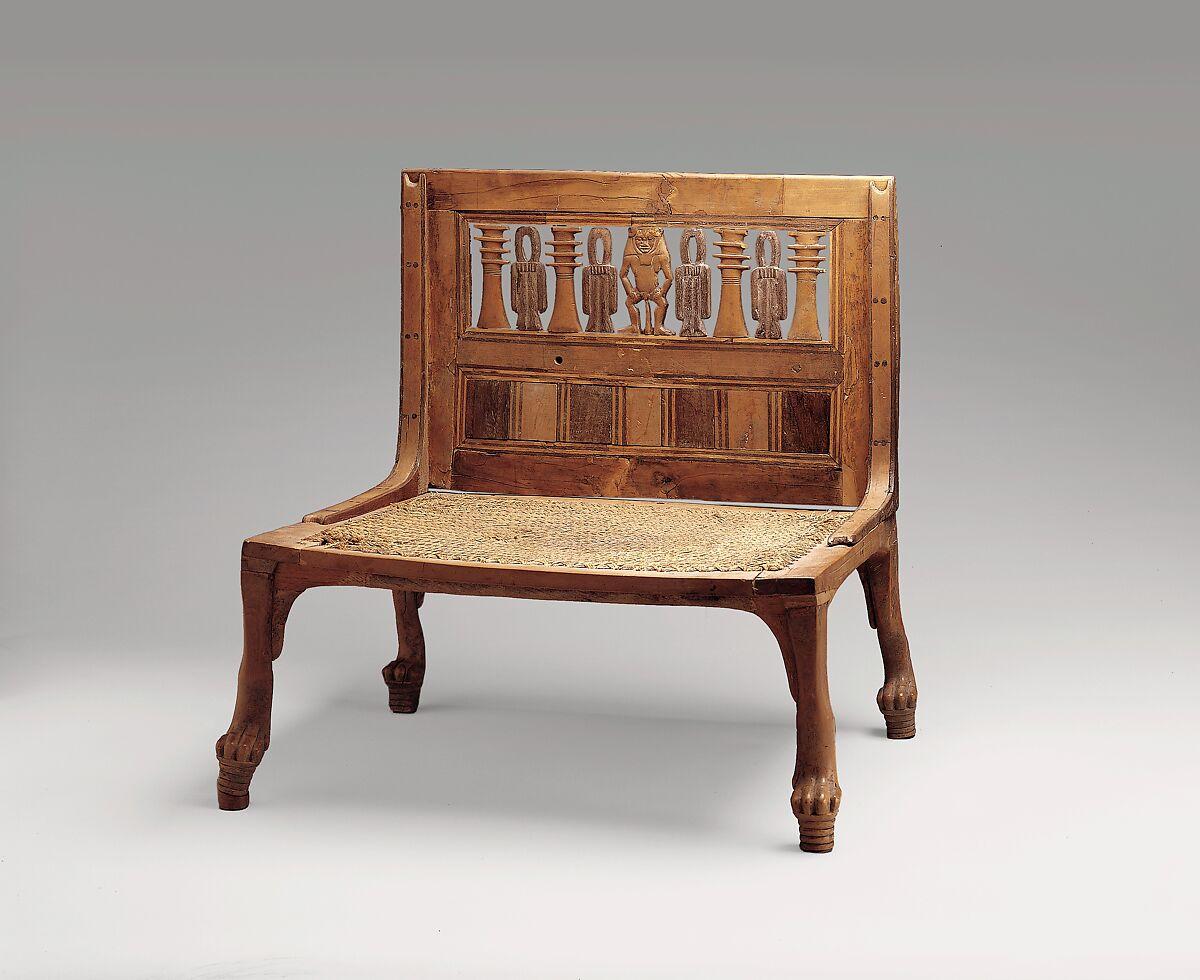
Consider a wooden chair belonging to Hatnefer, who lived during Egypt's Eighteenth Dynasty, approximately 1491–1473 BCE. Preserved in the collection of the Metropolitan Museum of Art, it offers a remarkable example of how meaning was incorporated into an everyday object.
Its construction employed mortise-and-tenon joints, wooden pegs, and resinous glue. Yet the chair was not simply an exercise in woodworking.
The backrest includes the figure of Bes, a protective deity associated with the home, alongside symbolic representations connected with Isis and the concept of stability and endurance.
Here, an object designed for sitting became a surface for communicating beliefs about safety, continuity, and life itself.
The ornament was not separate from the object. It was part of its identity.
This is an important distinction when considering the history of decorative arts. What might appear to a contemporary observer as an abundance of detail could have carried specific cultural meanings for its original owner.
The decorated object was simultaneously functional, symbolic, and beautiful.
The Mediterranean: Decoration as a Way of Life
The ancient Greeks and Romans developed their own elaborate relationships with decorative surfaces.
Greek pottery frequently carried scenes of mythology, warfare, athletic competition, and domestic life. The forms of the vessels were functional, but their painted surfaces transformed them into objects of cultural storytelling.
In Roman houses, decoration could extend across almost every architectural surface.
Mosaic floors, painted walls, sculptural gardens, fountains, and carefully arranged furnishings contributed to the experience of domestic space.
The surviving houses of Pompeii are particularly revealing.
Their frescoes demonstrate an extraordinary interest in creating imaginary architectural depth. Painted columns, landscapes, theatrical scenes, and illusionistic openings could make a wall appear to extend beyond its physical boundaries.
This was not merely an interest in adding more decoration.
It was an attempt to alter how a room was perceived.
A relatively enclosed interior could suggest a garden, a distant landscape, or an elaborate architectural setting.
The decorated surface became a form of spatial imagination.
And although the visual vocabulary differed from that of ancient Egypt, the underlying impulse was familiar: to make an inhabited environment richer than its basic structure.
II. Ornament as a Language of Civilisation
China: The Discipline Behind Decorative Richness
The decorative traditions of imperial China challenge the assumption that elaborate design is necessarily uncontrolled.
During the Tang dynasty (618–907 CE), artistic production reflected a cosmopolitan culture connected to trade networks extending across Central Asia and beyond. Ceramics, textiles, metalwork, and decorative motifs reveal an exchange of materials, techniques, and ideas.
Centuries later, the Ming dynasty (1368–1644) developed distinctive traditions of porcelain, lacquerware, furniture, and architectural ornament.
Ming furniture is particularly interesting because many of its most celebrated forms are relatively restrained.
Their elegance often emerges from proportion, joinery, the character of the wood, and the relationship between curved and straight lines.
Yet these objects existed within a much broader culture of sophisticated decorative arts.
This apparent contradiction reveals something important: a civilisation can appreciate both ornament and restraint without treating them as opposing philosophies.
The beauty of a simple wooden chair and the complexity of a painted porcelain vessel can belong to the same aesthetic world.
Abundance does not always require every individual object to be elaborate.
Sometimes, richness emerges from the relationship between objects.
India: Geometry, Nature, and the Sacred Surface
India's architectural and decorative traditions offer some of the most compelling examples of ornament as a cultural language.
Across different regions and historical periods, artisans developed intricate vocabularies of floral motifs, geometric patterns, sculptural narratives, painted surfaces, and material inlay.
These traditions were not uniform. Temple architecture in southern India, Mughal decorative arts in northern India, and the painted interiors of Rajasthan emerged from different religious, political, and artistic contexts.
Yet each demonstrates the extraordinary possibilities of the decorated surface.
The Brihadeeswara Temple at Thanjavur, completed around 1010 CE under the Chola ruler Rajaraja I, is an exceptional example.
Its monumental stone architecture combines sculptural representation with a highly disciplined architectural composition.
The carvings are not simply decorative additions. They participate in a larger religious and architectural system in which images, spatial arrangements, and ritual practices are interconnected.
What makes the building so remarkable is the coexistence of complexity and order.
From a distance, its monumental form appears coherent and controlled. Closer examination reveals layers of sculptural and architectural detail.
The eye moves between the whole and its individual parts.
This relationship between overall harmony and intricate detail is one of the most fascinating qualities of richly ornamented architecture.
The Taj Mahal: A Universe Within a Flower
Few monuments demonstrate the relationship between material, craftsmanship, and ornament as beautifully as the Taj Mahal.
Commissioned by Shah Jahan in memory of Mumtaz Mahal, the mausoleum was constructed in the seventeenth century and is celebrated for its architectural symmetry and luminous white marble.
At first glance, the Taj Mahal can appear almost minimalist.
Its great dome, balanced elevations, and carefully controlled proportions create a remarkably unified composition.
But move closer, and the apparent simplicity begins to unfold.
The marble surfaces contain intricate floral and geometric inlay work, incorporating coloured and semi-precious stones such as lapis lazuli, jade, and carnelian.
The technique, known in the region as parchin kari and often associated with the term pietra dura, involves cutting and fitting pieces of stone into a prepared surface to form precise decorative compositions.
A flower that appears delicate and effortless from a distance represents an extraordinary investment of time, knowledge, and manual skill.
This contrast is perhaps the Taj Mahal's most compelling design lesson.
Monumentality and delicacy are not opposites.
A building can be visually restrained in its overall silhouette and extraordinarily elaborate in its details.
There is another important aspect to this story.
The inlay tradition survives in Agra, particularly around Taj Ganj, where generations of artisans have practised the craft.
In 2025, UNESCO reported on initiatives to support these artisans, whose livelihoods face challenges from changing markets and declining opportunities.
The survival of ornament is therefore not merely an aesthetic question.
It is also a question of cultural continuity, skilled labour, and whether traditional knowledge can remain economically viable.
Rajasthan: Architecture Inspired by the Natural World
In Rajasthan, the historic palaces and forts of Jaipur, Jodhpur, and surrounding regions reveal another extraordinary tradition of decorative expression.
At Amer Fort, mirror work, painted surfaces, carved stone, and architectural geometry create richly layered interiors.
The Sheesh Mahal, or Mirror Palace, is especially revealing.
Its reflective surfaces demonstrate how ornament can interact with light, transforming the atmosphere of an architectural space.
Across Rajasthan, floral vines, peacocks, lotus motifs, geometric arrangements, and natural forms appear in paintings, textiles, carvings, and architectural details.
These patterns were shaped by long-established artistic traditions, patronage, religious symbolism, and the exchange of ideas between cultures.
Nature was an important source of inspiration, but artisans did not simply reproduce what they saw.
They translated natural forms into systems of rhythm, repetition, symmetry, and abstraction.
A flower became a motif. A vine became a border. A geometric shape became a repeating architectural screen.
Through repetition, individual details became part of a larger visual language.
What appears abundant is often carefully structured.
III. Why Are Human Beings Drawn to Ornament?
If we look beyond the history of architecture, an even more fundamental question emerges.
Why do human beings decorate?
Why have societies devoted so much effort to patterned textiles, painted pottery, carved furniture, jewellery, and ornamental architecture?
There is no single explanation.
Decoration can communicate identity, wealth, status, belief, memory, or social belonging. It can also provide sensory pleasure, demonstrate technical skill, or simply make an environment more engaging.
But one particularly interesting possibility lies in our relationship with nature.
Consider the structure of a leaf, the branching of a tree, the markings on a butterfly's wings, or the repeating geometry of a honeycomb.
The natural world contains an extraordinary variety of patterns.
Some are highly regular. Others combine repetition with irregularity.
The human eye is remarkably sensitive to these relationships.
We recognise symmetry, detect repetition, and notice differences within familiar forms.
It is tempting to see the decorative arts as an extension of this fascination.
Floral textiles, carved foliage, geometric tiles, and patterned ceramics often translate the visual complexity of nature into materials that can become part of our daily surroundings.
Yet we should be careful not to assume that every preference for ornament is biologically predetermined.
Taste is also learned.
What one culture considers elegant, another may regard as excessive. What appears richly decorated in one historical period may appear ordinary in another.
Our responses to colour and pattern are influenced by personal experience, cultural traditions, memory, and context.
This makes ornament especially interesting.
It exists somewhere between the universal human capacity to appreciate visual form and the highly particular meanings that different societies attach to it.
IV. The Nineteenth Century: When the Home Became a Work of Art
The nineteenth century marked an important turning point in the history of domestic decoration.
Industrialisation transformed the production and distribution of furniture, textiles, wallpapers, ceramics, and decorative objects.
Manufactured goods became increasingly available to expanding sections of the middle class, although access remained deeply unequal.
The Victorian interior became associated with upholstered furniture, patterned surfaces, framed pictures, ceramics, decorative lighting, and collections of personal possessions.
But Victorian interiors were far from aesthetically uniform.
Within the period, designers and reformers disagreed passionately about what a beautiful home should look like.
One particularly influential response was the Aesthetic Movement, which developed in Britain during the second half of the nineteenth century.
Associated with figures including James McNeill Whistler, Edward William Godwin, Christopher Dresser, and William Morris, the movement challenged conventional ideas about the relationship between art and everyday life.
Its advocates believed that ordinary domestic objects deserved serious artistic consideration.
A chair, wallpaper, ceramic vessel, or textile could possess aesthetic value independent of its practical function.
The Victoria and Albert Museum describes how this movement helped transform the domestic environment, encouraging the creation of artistic furniture and thoughtfully coordinated interiors.
One fascinating example is the work of Edward William Godwin.
His furniture often featured relatively light structures, straight lines, and restrained forms, contrasting with the heavier furniture associated with other Victorian tastes.
Yet it was designed to exist alongside ceramics, textiles, and carefully arranged decorative objects.
The Aesthetic interior could therefore be rich in objects without requiring every object to be heavily ornamented.
The distinction matters.
A visually layered home is not necessarily a room in which every surface competes for attention.
It can also be an environment in which contrasting forms, materials, and objects are brought into deliberate conversation.
William Morris and the Paradox of Beautiful Things
William Morris is especially important to this discussion.
A designer, writer, and influential figure in the Arts and Crafts movement, Morris believed that the quality and beauty of everyday objects mattered.
His wallpapers and textiles drew extensively from the natural world, transforming leaves, flowers, and branching stems into intricate repeating compositions.
But Morris was not simply advocating more decoration.
He was deeply concerned with the social conditions under which objects were produced.
For him, the relationship between design, labour, materials, and everyday life was fundamental.
His thinking raises a question that remains relevant today:
Can a richly decorated home also be a thoughtful, responsible one?
The answer depends less on the quantity of decoration than on the meaning, quality, and origins of the things we choose to live with.
V. The Twentieth Century: How Ornament Became Controversial
If ornament had been so central to human culture, why did it become a subject of such intense criticism?
The answer lies partly in the transformation of architecture and design during the early twentieth century.
Industrial production, new construction technologies, changing social ideals, and the search for a modern visual language encouraged designers to reconsider inherited decorative traditions.
One of the most provocative figures in this debate was the Austrian architect Adolf Loos.
In his influential essay and lecture Ornament and Crime, associated with the years around 1910, Loos attacked the unnecessary application of ornament to modern objects.
His argument was not merely aesthetic.
He connected ornament with questions of labour, production, cultural development, and economic waste.
Many of his claims reflected prejudices and assumptions that deserve critical scrutiny today. Nevertheless, his writing became an important reference point in debates about modern architecture and design.
The rejection of applied ornament was subsequently associated with influential strands of modernism.
Architects and designers increasingly explored clean surfaces, geometric forms, structural clarity, and the expressive potential of industrial materials.
But the popular story that modernism simply eliminated decoration is misleading.
The twentieth century also produced Art Deco, a movement that embraced luxurious materials, stylised motifs, geometric pattern, and sophisticated decorative finishes.
The 1925 International Exhibition of Modern Decorative and Industrial Arts in Paris helped establish Art Deco's international visibility.
Its designs combined modern geometry with ornament, demonstrating that technological progress did not necessarily require visual austerity.
Later, postmodern designers would challenge the seriousness and formal restraint of modernist architecture through colour, symbolism, historical references, and playful forms.
The history of modern design is therefore not a simple progression from decorated interiors to undecorated ones.
It is a continuing argument about what decoration means, where it belongs, and whether beauty should be expressed through surface, structure, material, or some combination of all three.
VI. Maximalism and Minimalism: A False Opposition?
Contemporary discussions often present maximalism and minimalism as opposing lifestyles.
One celebrates abundance. The other celebrates restraint.
One favours colour and pattern. The other is associated with quiet interiors and reduced possessions.
But these definitions are too simplistic.
Minimalism, in its broader artistic and design contexts, cannot be reduced to white walls and empty rooms.
Similarly, maximalism is not synonymous with clutter.
A room can contain relatively few objects and still feel visually extravagant because of its scale, colour, materials, or decorative intensity.
Another room may contain hundreds of objects yet feel coherent because of the relationships between them.
Consider a library.
Its shelves might hold thousands of books, each with a different spine, colour, size, and history.
Visually, the room contains an enormous amount of information.
Yet the repetition of shelving, the arrangement of volumes, and the familiarity of the objects can create a sense of order.
Abundance and coherence can exist together.
The same principle applies to a collection of ceramics, a gallery wall, or a room filled with inherited furniture.
The important distinction is between accumulation and curation.
Accumulation describes the gathering of things.
Curation involves selection, relationships, and meaning.
A maximalist interior becomes particularly interesting when its objects are connected by personal history, aesthetic intention, or cultural significance.
This does not mean that every object requires a profound story.
Sometimes beauty, humour, curiosity, or pleasure is reason enough.
But it does suggest that a meaningful interior cannot be measured simply by how much it contains.
VII. The Psychology of the Collected Home
A home is more than a physical arrangement of furniture and possessions.
It is also a record of the people who inhabit it.
Books, photographs, artworks, souvenirs, inherited objects, and everyday belongings can reveal aspects of identity that are difficult to express through words alone.
A worn chair may carry the memory of a grandparent. A ceramic bowl may recall a journey. A painting may represent a particular period of life.
Objects acquire significance through use, association, and time.
This is one reason why interiors designed entirely around a single trend can sometimes feel impersonal.
They may be visually coherent, but coherence alone does not necessarily create emotional attachment.
The collected home develops differently.
It evolves as its inhabitants change.
New objects enter. Others are repaired, relocated, inherited, or given away.
The interior becomes a kind of personal archive.
This does not mean that more possessions automatically produce greater happiness.
Excessive clutter can be stressful, and the relationship between domestic environments and wellbeing is complex.
But there is a meaningful difference between objects that feel burdensome and objects that contribute to a sense of identity or belonging.
Perhaps the strongest argument for thoughtful maximalism is not that abundance makes us happier.
It is that the objects we choose to preserve can help us maintain a relationship with our own histories.
VIII. The Contemporary Return of Decorative Expression
The renewed visibility of maximalism in contemporary interiors is part of a much wider cultural conversation.
During the 2010s, restrained interiors became particularly prominent across digital design media.
Neutral palettes, pale timber, uncluttered rooms, and carefully edited furnishings were widely reproduced through magazines, social platforms, and commercial interiors.
These aesthetics appealed for understandable reasons.
They offered visual calm, photographic clarity, and a sense of order in an increasingly complex world.
Yet their widespread reproduction also created a paradox.
A design philosophy associated with individuality and intentionality could become a highly recognisable commercial formula.
As interiors began to resemble one another, the desire for greater personal expression offered an alternative.
The COVID-19 pandemic added another dimension to this conversation.
For many people, homes became workplaces, classrooms, social environments, and places of extended isolation.
This intensified attention to domestic space, although it did not produce a single universal design response.
Some people sought greater simplicity.
Others became more interested in colour, comfort, collecting, and personalisation.
The current interest in maximalism can be understood partly within this broader reassessment of the home.
It also intersects with renewed attention to vintage furniture, decorative arts, historical references, and distinctive material combinations.
Contemporary maximalism is not one recognisable style.
It can appear as a richly layered traditional interior, a colourful postmodern apartment, a room filled with contemporary art, or an eclectic home assembled through years of collecting.
What connects these approaches is a willingness to allow different objects, periods, and visual languages to coexist.
IX. When Decoration Becomes an Experience
The renewed interest in expressive interiors is visible beyond the home.
Restaurants, hotels, galleries, and fashion boutiques increasingly use atmosphere as an essential part of their identity.
Lighting, texture, colour, furniture, and decorative objects can transform a commercial space into an environment with a distinctive personality.
Consider a richly layered restaurant interior.
Mirrors alter the perception of space. Patterned upholstery creates visual rhythm. Decorative lighting changes the atmosphere as the evening progresses. Artwork and architectural details contribute to the overall experience.
The space communicates before the food arrives.
Fashion boutiques can operate in a similar way.
In the interiors associated with designer Sabyasachi Mukherjee, antiques, textiles, artworks, and richly detailed furnishings help establish a visual world that extends beyond the clothing itself.
Such environments reveal an important quality of maximalist design.
Decoration can be immersive.
It can engage memory, imagination, cultural associations, and the senses.
But there is a distinction between a space designed to create an immediate impression and one intended to support everyday life.
A restaurant may benefit from theatrical intensity.
A home must also accommodate routine, rest, movement, and change.
The most compelling residential interiors recognise this difference.
They allow visual richness without forgetting the practical and emotional needs of their inhabitants.
X. The Ethics of Abundance
There is an uncomfortable contradiction at the centre of contemporary maximalism.
A philosophy that celebrates personal collections and expressive interiors can easily become another commercial invitation to consume.
More cushions. More objects. More patterns. More furniture.
The language of abundance can be used to justify endless acquisition.
Yet the history of decorative arts suggests another possibility.
Many of the objects we admire in museums today survived because they were valued, repaired, protected, inherited, or preserved.
Their significance developed over time.
A thoughtful approach to maximalism might therefore begin not with buying more, but with looking more carefully at what we already own.
Which objects have meaning?
Which deserve repair?
Which reflect our interests rather than the expectations of a passing trend?
Which might become more valuable to us through continued use?
This approach also invites greater respect for the labour behind decorative objects.
An intricately woven textile, carved wooden surface, or inlaid stone panel represents knowledge acquired through practice.
The visual complexity of an object can conceal the complexity of its making.
When traditional techniques disappear, we lose more than a particular decorative style.
We lose specialised skills, material knowledge, and connections between generations of makers.
Preserving these traditions requires more than admiration for their appearance. It requires serious attention to the people who practise them and the conditions that allow their work to continue.
The future of ornament is inseparable from the future of craftsmanship.
XI. Living With Meaning
Perhaps the most interesting aspect of maximalism is that it challenges the idea of a universally perfect interior.
A home does not need to resemble a magazine photograph.
It does not need to belong entirely to one historical period, colour palette, or decorative style.
A contemporary chair can sit beside an antique cabinet. A restrained architectural interior can contain a vividly patterned textile. A family photograph can share a wall with a painting acquired during travel.
The resulting space may not conform to a single design category.
But it may communicate something far more important: the life of the person who inhabits it.
Throughout history, ornament has served many purposes.
It has expressed devotion, authority, prosperity, imagination, memory, and artistic skill.
At times, it has celebrated wealth and power. At others, it has brought beauty to ordinary domestic life.
It has been admired, rejected, revived, and reinterpreted.
What remains constant is our desire to make the world around us meaningful.
Perhaps that is why the debate between maximalism and minimalism feels increasingly inadequate.
The question is not whether a room contains too much or too little.
It is whether the things within it deserve their place.
A meaningful home might be almost empty.
It might also be filled with books, paintings, textiles, furniture, and objects gathered over decades.
Both can express the same underlying intention: to live among things that matter.
Abundance, at its most thoughtful, is not the opposite of restraint. It is the freedom to choose what deserves our attention, our affection, and a place in our lives.
And perhaps that is the true art of abundance.
Share:
The Geometry of Infinity