
Jute, the Ancient Art of Weaving, and the Return of Natural Materials
There is something profoundly familiar about woven fibre.
Perhaps it is the rhythm of the strands, passing over and beneath one another. Perhaps it is the irregularity of natural materials, where no two fibres are quite identical. Or perhaps it is the knowledge that weaving belongs to one of humanity's oldest traditions of making—an activity that predates written history and continues to shape the objects we use every day.
Long before weaving became associated with decorative textiles, it was a practical means of survival. People intertwined grasses, reeds, bark fibres, and other plant materials to create containers, coverings, cordage, and useful surfaces.
The principle was deceptively simple: individual fibres, relatively limited in strength or structure, could become something more substantial through their arrangement.
Over thousands of years, that principle gave rise to an extraordinary diversity of materials and techniques.
Among the plant fibres that have played an important role in this history is jute.
Often recognised through the coarse texture of burlap sacks or agricultural rope, jute possesses a far richer material identity than its utilitarian associations suggest.
It has shaped agricultural economies, connected continents through trade, and provided the foundation for countless woven objects.
Today, as designers reconsider the relationship between natural materials, skilled labour, and contemporary living, jute is being encountered in new ways.
To understand its possibilities, however, we must begin not in a furniture workshop, but in the fields where it grows.
I. A Fibre Born from the Monsoon
Jute comes primarily from two cultivated plant species: Corchorus capsularis, commonly associated with white jute, and Corchorus olitorius, often called tossa jute.
Both belong to the genus Corchorus, and both are grown for the long fibres found within their stems.
Unlike cotton, whose fibres develop around seeds, jute is a bast fibre.
Bast fibres are obtained from the inner bark region of certain plants. Other familiar bast fibres include flax and hemp.
This distinction matters because the structure of the plant determines the character of the material.
Jute fibres are relatively long, strong, and naturally coarse. They contain cellulose alongside hemicellulose, lignin, and other components that influence their stiffness, colour, and behaviour.
The fibre's characteristic golden-brown appearance has helped give jute its familiar description as the golden fibre.
Its colour is not entirely uniform. Depending on the species, growing conditions, processing, and grading, jute may range from pale cream and warm straw to deeper brown.
These variations are part of its material identity.
The Geography of Jute
Jute cultivation is closely associated with the warm, humid conditions of the Bengal region, now divided between India and Bangladesh.
The region's monsoon climate, fertile alluvial soils, and agricultural knowledge have supported a major jute economy for generations.
The crop is typically grown during the warmer, wetter part of the year.
Its growth is comparatively rapid, with harvesting commonly taking place after roughly three to four months, depending on the variety and cultivation conditions.
As the plants mature, they develop tall, slender stems containing the fibres that will eventually be extracted.
What appears in a finished woven surface as a soft brown strand begins as part of a living plant.
This agricultural origin is easy to overlook.
A woven object can seem removed from the field, rainfall, soil, and seasonal labour that made it possible.
Yet all of these remain embedded in the material's history.
II. From Stem to Strand: The Remarkable Process of Retting
Jute fibre cannot simply be pulled from a freshly harvested stem in the same way that thread can be unwound from a spool.
The useful fibres are bound to surrounding plant tissues.
Separating them requires a process known as retting.
Traditionally, harvested jute stems are gathered into bundles and immersed in water.
Microorganisms gradually break down some of the substances that bind the fibres to the woody stem.
Once retting has progressed sufficiently, the fibres can be separated, washed, and dried.
The process relies on a carefully managed biological transformation.
Too little retting can make extraction difficult and leave unwanted material attached.
Excessive retting may weaken or damage the fibres.
Water conditions, temperature, microbial activity, and the quality of the harvested crop all influence the outcome.
This means that the appearance and performance of jute begin to take shape long before spinning or weaving.
The fibre is not simply manufactured.
It is cultivated, biologically processed, cleaned, graded, and prepared.
The Human Knowledge Behind the Material
Traditional fibre extraction depends upon observation and experience.
Workers assess the condition of the stems, the progress of retting, and the readiness of the fibre.
These judgements may appear routine, but they represent accumulated practical knowledge.
The difference between an ordinary bundle of plant stems and usable textile fibre depends on a sequence of decisions.
Modern research continues to investigate improved retting methods, including approaches that reduce water use and environmental impacts while maintaining fibre quality.
The existence of such research is a reminder that natural materials are not automatically environmentally harmless.
Their sustainability depends on how they are grown, processed, transported, and used.
III. Before the Loom: The Origins of Weaving
Weaving is one of humanity's most ancient technologies.
Archaeological evidence from different regions demonstrates that people were making textiles and using plant fibres thousands of years before the development of industrial manufacturing.
Some of the earliest surviving evidence takes the form of impressions left in clay, mineralised fragments, and preserved fibres.
Such discoveries are important because organic materials rarely survive intact over very long periods.
Wood, plant fibres, and woven textiles decompose under ordinary environmental conditions.
Consequently, the archaeological record preserves only a fraction of the objects that people once made.
It would be misleading to assign weaving a single birthplace or inventor.
Different societies developed methods of interlacing available materials, sometimes independently and sometimes through cultural exchange.
What unites these traditions is a fundamental structural idea.
One set of elements passes across another.
Through repeated interlacing, flexible strands become a stable surface.
Warp and Weft
In conventional textile weaving, the two principal systems are known as warp and weft.
The warp consists of threads held in tension, generally running lengthwise on a loom.
The weft passes across them.
The simplest arrangement is plain weave, in which each weft thread alternates over and under successive warp threads.
On the following row, the sequence is reversed.
This produces a balanced interlocking structure.
The principle is simple enough to be understood visually, yet it forms the foundation of an enormous range of textile traditions.
More complex weaving arrangements emerge when the number, sequence, spacing, or grouping of strands changes.
The history of weaving is therefore not merely a history of different materials.
It is also a history of structural invention.
IV. The Basket-Weave Principle
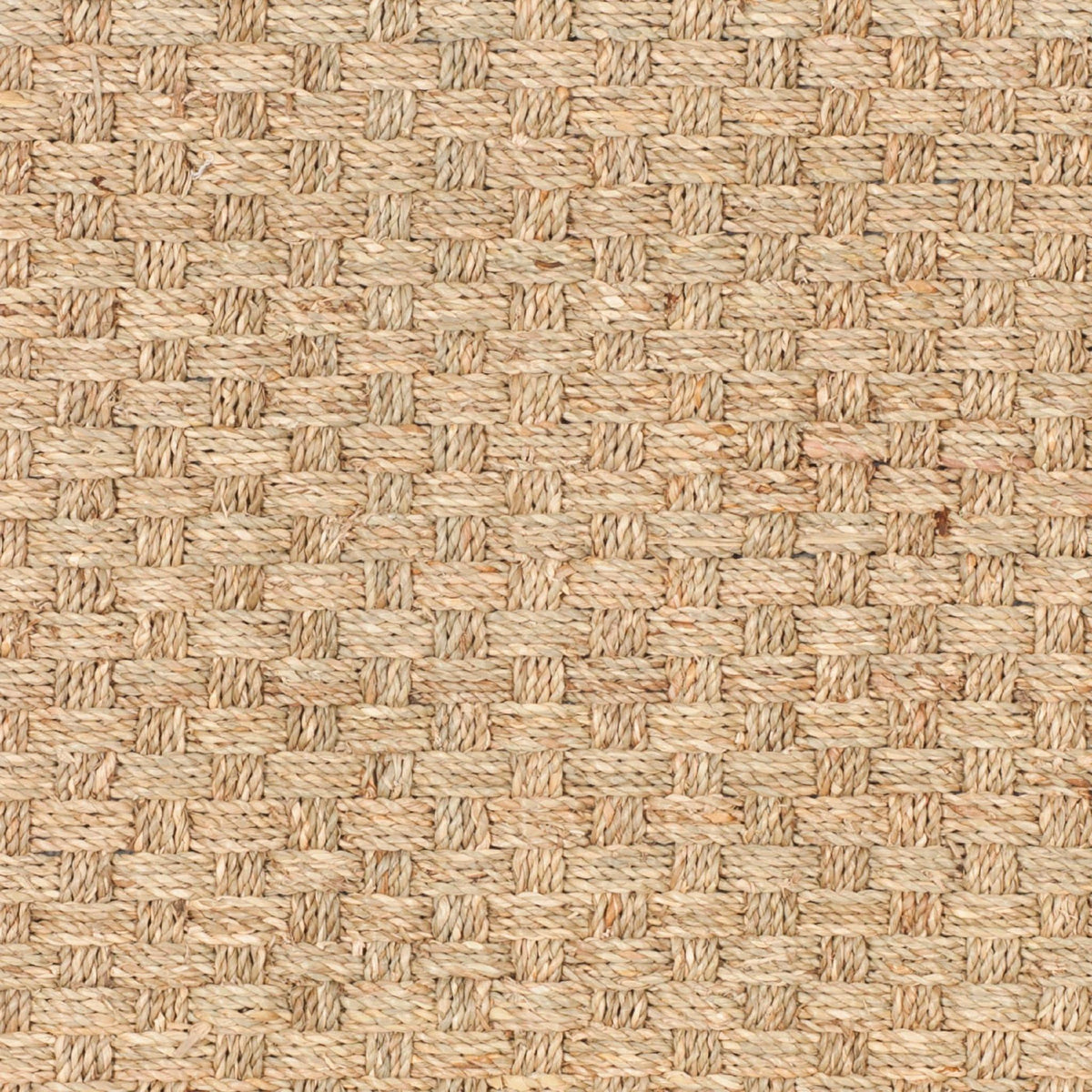
The woven panels illustrated in the Tantu Collection employ a broad, basket-like interlacing rhythm.
The surface is composed of substantial jute strands arranged into horizontal and vertical bands.
Rather than disappearing into a fine textile texture, the strands remain visibly individual.
This gives the weave a pronounced architectural quality.
The eye can follow the movement of the material as it passes over and beneath adjoining elements.
The resulting grid creates a rhythm of raised surfaces and recessed spaces.
How Basket Weave Differs from Plain Weave
In a conventional plain weave, individual threads alternate over and under one another.
Basket weave is closely related, but groups of adjacent threads or strands are treated as units.
For example, two strands may pass over two others before passing beneath the next pair.
The arrangement can produce a larger, more pronounced checkerboard effect.
In thicker materials, this structure becomes especially visible.
The woven surface appears to consist of small rectangular blocks, each defined by the direction of the strands.
The term basket weave is used across textiles and basketry, but the exact construction can vary considerably.
In the Tantu photographs, the visible surface resembles a coarse, grouped over-and-under interlacing, with dense vertical wrapping above and below the central woven sections.
Without examining the construction directly, it would be inappropriate to assign an exact technical weave notation.
What is clear is the design's emphasis on the structural relationship between the strands.
The weave is not concealed.
It is the principal decorative element.
V. Why Repetition Feels So Natural
Repeated patterns have occupied an important place in architecture and decorative arts throughout history.
Geometry offers one form of repetition.
Weaving offers another.
The difference is that woven repetition is both visual and physical.
Every crossing point is part of the structure.
A decorative geometric pattern may be painted onto a surface, but in a woven surface the pattern is created by the material's movement.
Form and construction become inseparable.
This relationship is especially apparent in coarse natural-fibre weaving.
The thickness of the strands creates shadows.
Small variations in tension alter the surface.
The natural colour differences between fibres produce subtle tonal changes.
Even when the underlying structure is regular, the result is never perfectly mechanical in appearance.
There is order, but also variation.
It is this balance that makes woven natural materials particularly compelling.
They offer the reassurance of repetition without eliminating the character of the material.
VI. Jute Before Industrialisation
Long before jute became a globally traded industrial fibre, it was used in Bengal and neighbouring regions for practical purposes.
Local communities made rope, cordage, coarse cloth, and sacks from the fibre.
These applications reflected its useful combination of strength, availability, and suitability for relatively heavy-duty woven structures.
The material was particularly well suited to agricultural and commercial packaging.
Jute sacks could be used to hold grain and other commodities, while jute cordage served numerous practical functions.
These uses might seem distant from the world of contemporary interiors.
Yet they reveal the qualities that continue to make jute relevant.
It can be twisted into substantial strands.
It can be woven into dense or open structures.
It possesses a distinctive surface texture.
And its strength makes it useful in applications where delicate fibres would be unsuitable.
The transition from agricultural packaging to decorative furniture does not erase this utilitarian history.
It builds upon it.
VII. Bengal, Dundee, and the Industrial History of Jute
The nineteenth century transformed jute from a regional agricultural material into an internationally important industrial commodity.
The story is inseparable from the expansion of British imperial trade.
Raw jute from Bengal was shipped to Britain, where manufacturers sought ways to process it mechanically.
Dundee, a Scottish city with an established textile industry, became one of the most important centres of mechanised jute production.
By the 1830s, technical experiments had helped establish practical methods for spinning and weaving the fibre in factories.
Jute presented difficulties for early machinery because of its stiffness and coarse character.
Manufacturers developed methods of softening and preparing the fibre for mechanical processing.
As the industry expanded, Dundee became closely identified with jute manufacturing.
Factories produced sacks, cloth, and other materials for international trade.
The Contradictions of Industrial Progress
The industrialisation of jute increased production and created new employment, but it also reflected the unequal economic relationships of colonial trade.
Raw materials were cultivated in Bengal while substantial manufacturing capacity and commercial profits developed in Britain.
Industrial labour brought its own hardships, including demanding working conditions and economic insecurity.
Women formed a significant part of Dundee's jute workforce.
The material's history therefore includes not only agricultural skill and technological innovation, but also questions of labour, empire, and economic power.
Manufacturing Returns to Bengal
During the nineteenth century, mechanised jute manufacturing also expanded around Calcutta, now Kolkata.
Mills developed along the Hooghly River, benefiting from access to transport, labour, and raw materials.
Over time, the region became a major centre of industrial jute production.
The geography of the industry was altered again by the Partition of British India in 1947.
Much of the jute-growing territory lay in East Bengal, which became East Pakistan and later Bangladesh, while many established mills remained in India.
This separation of agricultural production and industrial infrastructure had significant economic consequences.
The history of jute is thus also a history of changing borders and interconnected regional economies.
VIII. From Industrial Fibre to Interior Material
For much of its modern history, jute has been associated with practicality.
Sacking, agricultural packaging, ropes, and coarse woven cloth shaped its public identity.
But materials do not possess fixed cultural meanings.
Their significance changes according to how they are used.
The same fibre that forms a grain sack can also become a rug, a woven wall covering, a decorative panel, or a furniture surface.
The difference lies in the treatment of the material.
Scale, proportion, construction, and context can transform how it is perceived.
When jute is woven into a carefully considered furniture panel, its texture becomes an aesthetic feature.
The coarse strand is no longer something to disguise.
Its irregularity becomes part of the design.
This is an important departure from the assumption that refinement must always mean smoothness.
Natural materials often communicate their character through visible variation.
Wood reveals grain.
Stone reveals mineral structure.
Jute reveals the individual fibres from which the strand is formed.
In each case, the material contributes its own visual language.
IX. Tantu: An Interpretation of Material and Structure
The name Tantu draws upon a word associated with thread or fibre in Sanskrit and several Indian languages.
It is an appropriate name for a collection in which the visible organisation of fibres forms the central design element.
The Tantu Collection brings together natural jute weaving, warm-toned timber, and restrained metal frameworks.
Its visual character emerges from the relationship between these materials rather than from applied ornament.
The timber establishes a clear structural boundary.
The jute introduces texture and repetition.
The metal elements provide a contrasting linear detail.
Together, they create a composition that is visually quiet but materially expressive.
The Woven Surface
The close-up photograph reveals the most important aspect of the collection.
Substantial strands cross one another in a regular sequence, producing an interlocking grid.
The strands are not perfectly smooth.
Individual fibres catch the light, creating small variations in texture.
The spaces between the crossings introduce shadow and depth.
This is what gives the surface its distinctive character.
From a distance, the panel reads as a unified woven field.
At close range, it becomes a sequence of individual material relationships.
The eye moves from the whole to the detail.
The Role of Wood
Wood and jute possess different physical properties, yet they share a visual connection through their natural origins.
The timber frame provides a defined edge around the woven panel.
It also creates a contrast between the solid mass of the cabinet and the textured surface of the fibre.
This contrast is essential.
Without the frame, the weaving might read primarily as textile.
Within the frame, it becomes part of an architectural furniture composition.
The woven surface is given a boundary, scale, and structural context.
A Collection Built Around Variation
The collection includes cabinets and chests with different proportions and configurations.
Some forms are tall and narrow.
Others are wider and lower.
Despite these differences, the repeated woven surface creates visual continuity.
The design language remains recognisable without requiring every piece to have the same shape.
This is one of the strengths of a material-led collection.
Its identity does not depend on repeating an identical silhouette.
It emerges through a consistent relationship between materials, textures, and construction.
X. The Material Intelligence of Weaving
A woven panel may appear straightforward, but its quality depends upon several interacting factors.
The thickness of the strands affects the scale of the pattern.
Their flexibility influences how they bend around crossing points.
Tension determines how evenly the surface sits.
Spacing controls the balance between density and openness.
The frame influences how the weaving is secured and supported.
A change in any one of these factors can alter the finished appearance.
This is why weaving should not be understood simply as a decorative process.
It is a form of structural problem-solving.
The maker must anticipate how the material will behave.
Natural fibres can vary in thickness, stiffness, and response to humidity.
A successful woven surface must accommodate these characteristics.
The Importance of the Hand
The value of skilled weaving is not necessarily expressed through complicated motifs.
Sometimes it is visible in consistency.
A repeated over-and-under structure requires careful control of spacing and tension.
The work can be repetitive, but repetition does not make it effortless.
It demands concentration.
The apparent simplicity of the finished surface can conceal the decisions required to produce it.
This is a recurring characteristic of material craftsmanship.
The more resolved an object becomes, the less visible its difficulties may appear.
XI. Is Jute Really a Sustainable Material?
Jute is frequently described as an environmentally preferable alternative to synthetic fibres.
There are sound reasons for this reputation.
It is a plant-derived, renewable material.
Under suitable conditions, untreated jute fibre is biodegradable.
It can be used in products that might otherwise rely on petroleum-derived materials.
However, these qualities do not automatically make every jute product sustainable.
Environmental performance depends upon the entire life cycle of an object.
Cultivation, retting, spinning, dyeing, finishing, transportation, assembly, use, and disposal all matter.
The Environmental Cost of Retting
Traditional water retting can affect the quality of rivers, ponds, and other water bodies.
As microorganisms break down plant tissues, the process can increase biological oxygen demand and reduce dissolved oxygen in the water.
Scientific studies have documented these changes and their potential consequences for aquatic ecosystems.
Improved processing methods can help reduce some of these impacts.
This is an important qualification.
A natural material can have environmental advantages while still requiring responsible production practices.
Finishes and Mixed Materials
A finished piece of furniture is rarely made from fibre alone.
It may include timber, metal, adhesives, coatings, and other components.
These materials influence durability, repairability, and end-of-life treatment.
Claims about biodegradability must therefore distinguish between untreated jute fibre and the finished product.
A cabinet containing jute, wood, metal, and synthetic finishes cannot automatically be described as entirely biodegradable.
Durability as a Form of Responsibility
One of the most meaningful environmental considerations is how long an object remains useful.
A piece designed for repair, care, and extended use may offer a different environmental proposition from a disposable object, regardless of the material from which it is made.
This does not eliminate the importance of responsible sourcing.
It broadens the question.
Sustainability is not only about what an object is made from.
It is also about how it is made, how it is used, and how long it remains valued.
XII. The Beauty of Imperfection
Industrial manufacturing has accustomed us to surfaces that are highly consistent.
Colours can be standardised.
Textures can be replicated.
Patterns can be repeated with exceptional precision.
Natural fibre offers a different experience.
Its variations are often small, but they are visible.
One strand may be slightly darker.
Another may have a different thickness.
The twist of the fibre may catch the light in a different way.
These characteristics need not be treated as defects.
Within reasonable standards of quality and construction, they can contribute to the individuality of a material.
The distinction is between natural variation and poor workmanship.
A carefully made woven panel should still be structurally sound, appropriately tensioned, and well finished.
But it need not imitate the uniformity of a synthetic surface.
Its character comes partly from the fact that it remains recognisably natural.
XIII. The Return of Tactility
Contemporary interiors are increasingly discussed in terms of sensory experience.
How does a material feel?
How does it respond to light?
Does it appear warm or cool?
Does its surface encourage closer observation?
These questions are particularly relevant to woven materials.
Jute introduces a pronounced tactile quality.
Its surface is not perfectly flat.
The interlacing creates relief.
The fibre's natural colour produces subtle variations in tone.
Placed alongside timber, stone, plaster, or metal, it contributes another layer of material experience.
This does not require an elaborate decorative scheme.
In fact, textured materials can be especially expressive in otherwise restrained interiors.
A relatively simple furniture silhouette can acquire visual depth through the character of its woven surface.
The ornament is already present in the construction.
XIV. A Thread Between Past and Present
The history of jute is not a straightforward journey from an ancient craft to a modern design trend.
It is a story of agriculture, local knowledge, industrial transformation, global trade, and changing cultural values.
It includes the fields of Bengal, the factories of Dundee, the mills of Kolkata, and the continuing work of people who cultivate and process natural fibres.
It also belongs to the much older history of weaving—a practice that demonstrates how simple strands can be transformed through repetition, tension, and structure.
The Tantu Collection represents one contemporary expression of these possibilities.
Its significance lies not in claiming to recreate an ancient object, but in drawing upon enduring material principles.
The visible weave acknowledges the character of the fibre.
The timber provides structure.
The composition allows texture to become ornament.
And the finished objects invite a different way of looking at a material often associated with purely practical use.
There is something quietly radical in this shift.
A fibre once valued primarily for its utility becomes worthy of close attention.
Its irregularities become visible.
Its construction becomes the design.
Its history becomes part of the object.
Perhaps the most compelling quality of jute is not that it is natural, traditional, or newly fashionable.
It is that its transformation remains understandable.
We can still recognise the strand.
We can still follow its movement.
We can still see how one element passes over another to create something larger than itself.
In a world of increasingly complex manufactured surfaces, weaving reminds us that beauty can begin with the simplest possible gesture: one thread crossing another.
Share:
The Geometry of Infinity