
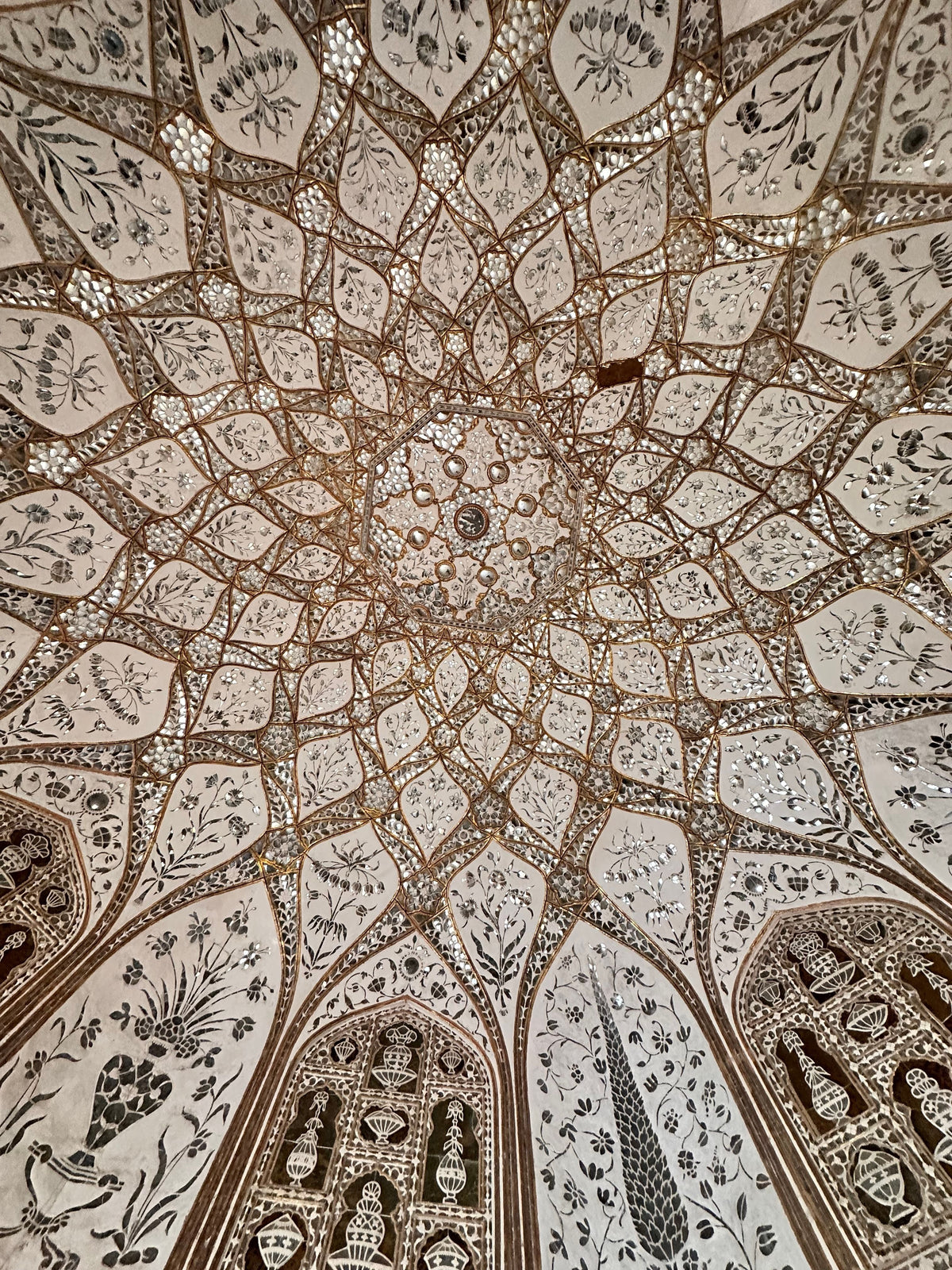
From the mirrored chambers of historic palaces to contemporary architectural installations, an exploration of Thikri craftsmanship, the poetry of reflected light and the possibilities of bespoke mirror inlay wall panels.
Architecture Made of Light
There are surfaces that define a room and others that transform the experience of being within it.
The mirrored interiors of India's historic Sheesh Mahals belong to the latter tradition. Thousands of small reflective fragments, arranged into elaborate compositions, turn solid walls into surfaces that appear to shimmer, deepen and move with the changing light.
Unlike a conventional mirror, which presents a continuous reflection, these decorated surfaces break light into countless smaller impressions. A flame becomes a constellation. A passing movement produces a succession of glimmers. The architecture seems to extend beyond its physical boundaries.
At the heart of many of these interiors is an extraordinary decorative tradition known as Thikri art, a form of mirror and glass mosaic work closely associated with the palaces, havelis and historic interiors of Rajasthan.
For centuries, this technique has demonstrated how fragments of a relatively simple material can create an astonishing architectural effect.
Today, its visual language offers compelling possibilities for interior designers, architects and homeowners seeking something beyond conventional wall finishes.
A Sheesh Mahal-inspired installation need not reproduce the elaborate interiors of a royal palace. It might take the form of a single decorative wall panel, a carefully proportioned entrance feature, a contemporary geometric composition, or an entire wall conceived as an artwork.
To understand how this tradition can find a place in modern interiors, we must first understand the relationship between glass, ornament and architecture.
I. What Is Thikri Art?
Thikri, also written as Thikari, is a traditional decorative technique in which small pieces of mirror or glass are cut, shaped, and arranged to form intricate patterns.
The pieces may be incorporated into a prepared plaster surface or another suitable backing, depending on the technique and intended application.
The resulting decoration can include floral compositions, geometric arrangements, borders, medallions, and elaborate ornamental fields.
Individual reflective pieces are often remarkably small. Their shape, orientation, and spacing determine the character of the finished surface.
A single fragment may seem insignificant.
Hundreds or thousands of fragments, carefully positioned, become an intricate composition of reflection and shadow.
The craft is closely associated with Rajasthan's architectural traditions, where decorative surfaces were developed through a rich exchange of regional and courtly artistic influences.
Yet Thikri should not be understood merely as an exercise in attaching mirrors to a wall.
Its sophistication lies in composition.
The maker must consider the pattern as a whole while attending to the position of every individual element.
The reflective surface becomes both material and ornament.
II. The Sheesh Mahal: A Palace of Mirrors
The expression Sheesh Mahal is commonly translated as Palace of Mirrors.
It describes a type of richly decorated architectural space rather than one single building or a single method of construction.
Across different historic palaces, mirror ornament appears alongside painted plaster, carved stone, architectural niches, and other decorative techniques.
One of the best-known examples is the Sheesh Mahal at Amer Fort, near Jaipur.

Within this historic palace complex, intricate mirror and glass decoration covers architectural surfaces, creating a remarkable relationship between ornament and illumination.
The interior is celebrated for the way numerous small reflective elements respond to light.
Accounts of the chamber frequently describe the effect of lamps reflected across its surfaces, producing an impression reminiscent of a star-filled sky.
Whether illuminated by traditional lamps or viewed in contemporary conditions, the underlying design principle remains compelling: a relatively limited light source can generate a complex visual experience through repeated reflection.
The mirrors do not simply decorate the architecture.
They change the way the architecture is perceived.
Beyond Amer
Mirror-decorated interiors can also be found elsewhere in Rajasthan.
The Sheesh Mahal at Mehrangarh Fort in Jodhpur presents a different architectural expression, incorporating mirror ornament within a richly decorated historic setting.
At Samode Palace, near Jaipur, reflective surfaces contribute to an interior characterised by elaborate decoration and courtly splendour.
These examples demonstrate that the Sheesh Mahal tradition was never limited to one fixed pattern or decorative formula.
Different patrons, artisans, architectural settings, and periods produced distinctive interpretations.
What connects them is a shared fascination with the expressive potential of reflected light.
III. A History of Cultural Exchange
The development of mirror ornament in Indian architecture cannot be separated from the broader history of decorative arts across South Asia, Persia and neighbouring regions.
Courtly architecture developed through centuries of exchange involving artisans, materials, techniques, and aesthetic ideas.
Mughal and Rajput architectural traditions drew upon multiple influences while developing their own regional identities.
Geometric ornament, floral arabesques, carved surfaces, painted decoration, and intricate inlay all became important elements of this visual culture.
Mirror work participated in this larger decorative environment.
However, it would be misleading to attribute every surviving Thikri technique to one inventor, one palace, or one precise historical moment.
The documentary history of individual craft practices is often incomplete, and techniques may evolve through workshops and generations of artisans without leaving detailed written records.
What survives most vividly is the work itself.
Historic mirror-decorated interiors reveal a sophisticated understanding of pattern, surface, and light.
They also demonstrate that decorative architecture was rarely the product of a single craft.
Painters, plaster workers, glass specialists, designers, and other skilled makers contributed to the finished environment.
The result was an integrated architectural composition rather than an isolated decorative treatment.
IV. How Thikri Mirror Work Is Made
The visual complexity of Thikri emerges from a sequence of careful processes.
Although methods vary between workshops and applications, traditional mirror mosaic work generally involves the preparation of a design, shaping of reflective elements, preparation of a suitable surface, and precise placement of the individual pieces.
The Design
The process begins with a composition.
This may be an intricate floral arrangement, a repeating geometric field, an ornamental border, or a design developed specifically for an architectural space.
The relationship between the pattern and its surroundings is important.
An arched recess may call for a radiating composition.
A long horizontal wall may suit a repeated ornamental arrangement.
A smaller panel may be organised around a central medallion.
In each case, the design must respond to scale and proportion.
Cutting and Shaping the Glass
Individual mirror or glass pieces are prepared to suit the pattern.
Traditional Thikri work is associated with small, carefully shaped elements, including curved and faceted pieces.
The reflective quality of the finished surface depends not only on the presence of glass, but also on the shape and orientation of these elements.
Flat and curved reflective surfaces can produce different effects.
A subtle change in angle can alter the direction of reflected light.
This makes the positioning of the pieces particularly important.
Preparing the Surface
Historically, mirror ornament was often integrated into plaster-based decorative surfaces.
Traditional systems could involve lime-based materials and other specialised preparations.
Contemporary installations may use different substrates, adhesives, and construction methods, particularly when the design is produced as a transportable panel rather than executed directly onto a wall.
These approaches should not be assumed to be technically interchangeable.
The correct system depends on the intended location, panel dimensions, environmental conditions, and installation requirements.
Placing the Pieces
The reflective elements are positioned according to the design.
A successful composition requires consistency of spacing, careful alignment, and attention to the surrounding material.
The final effect emerges gradually.
What begins as a drawing becomes a surface in which the decorative pattern and the reflected light operate together.
The maker is working not only with glass, but with the spaces between the glass.
V. The Language of Thikri Patterns
One of the most fascinating qualities of Thikri art is its ability to accommodate very different ornamental languages.
Floral and Botanical Compositions
Flowers, leaves, curling stems, and stylised vines are among the most expressive forms associated with traditional decorative interiors.
Their curved lines allow reflective pieces to form delicate arrangements that catch light from different directions.
Floral mirror work can appear elaborate and richly detailed, particularly when combined with painted or plaster ornament.
In contemporary interiors, the same vocabulary can be simplified into a restrained botanical composition.
Geometric Patterns
Geometric Thikri designs offer a different character.
Stars, diamonds, polygons, and repeated angular arrangements introduce order and rhythm.
These compositions can be particularly effective in contemporary architectural spaces because they relate naturally to the straight lines of doors, walls, furniture, and structural grids.
The scale of the geometry is important.
Small repeated elements can create a dense, almost textile-like surface.
Larger geometric forms can read as architectural statements from across a room.
Borders and Architectural Frames
Not every mirror inlay installation needs to cover an entire wall.
Ornamental borders can define doorways, arches, niches, and framed wall sections.
A mirror-inlaid surround may emphasise an existing architectural feature without overwhelming it.
This approach is especially useful where the room already contains strong decorative elements.
Medallions and Central Compositions
A central motif can create a natural focal point.
Radial arrangements, symmetrical floral compositions, and geometric medallions are particularly suitable for walls designed to be viewed frontally.
The surrounding negative space becomes as important as the ornament itself.
A well-proportioned composition allows the eye to rest.
VI. From Palace Walls to Contemporary Interiors
The contemporary appeal of Thikri lies in its ability to create visual richness without depending entirely on colour.
A reflective surface changes throughout the day.
Morning light produces one effect.
Indirect afternoon light produces another.
At night, carefully positioned architectural lighting can reveal the depth and texture of the mosaic.
This makes mirror inlay particularly interesting for interiors where atmosphere is an important part of the design.
The challenge is not necessarily to reproduce historical ornament in its entirety.
It is to identify which qualities of the tradition remain relevant.
Reflection.
Repetition.
Material detail.
The relationship between surface and light.
These principles can be interpreted within a wide range of contemporary spaces.
VII. Where Can Sheesh Mahal-Inspired Wall Panels Be Used?
Living Rooms and Residential Interiors
A mirror inlay feature wall can become a defining element in a living room.
Behind a sofa, within a recessed wall, or as a framed decorative installation, it can introduce texture and reflection without requiring additional artwork.
The surrounding materials influence the result.
Natural timber, stone, plaster, and restrained upholstery can provide a quiet backdrop for an intricate mirrored composition.
In more expressive interiors, Thikri can participate in a layered decorative scheme alongside patterned textiles, sculptural lighting, and collected objects.
The important consideration is balance.
A visually elaborate wall often benefits from thoughtful restraint elsewhere.
Entrance Halls and Foyers
An entrance is often the first opportunity for a space to establish its identity.
A custom mirror inlay panel can create an immediate sense of arrival.
Narrow vertical compositions may suit transitional spaces, while larger feature walls can work within generous foyers.
Because entrances often contain limited natural light, the relationship between mirror work and artificial illumination deserves particular attention.
A carefully lit panel can become a focal point without relying on excessive brightness.
Dining Rooms
Dining spaces offer a particularly interesting setting for decorative mirror work.
The changing light of a dining environment—daylight, pendants, wall lights, and candles—can animate a reflective surface.
A large composition behind a dining table may establish the room's visual identity.
However, the design should consider seated eye levels and the position of direct light sources to avoid uncomfortable reflections.
Bedrooms
In bedrooms, a more restrained interpretation may be appropriate.
Mirror inlay can be incorporated into a decorative wall behind a bed, within framed panels, or as a smaller architectural accent.
Subtle patterns and carefully controlled lighting can create an atmosphere that feels intimate rather than theatrical.
Hotels and Hospitality Interiors
Boutique hotels, restaurants and hospitality spaces often seek distinctive architectural features that contribute to a memorable guest experience.
Thikri offers opportunities for feature walls, reception backdrops, decorative niches, private dining rooms, and other carefully selected locations.
In commercial settings, aesthetic decisions must be accompanied by appropriate technical planning.
Fire and building regulations, cleaning requirements, impact resistance, public safety, and long-term maintenance may influence the specification.
Boutique Retail and Cultural Spaces
Mirror inlay can also create an expressive backdrop for retail displays, galleries, and other environments where material identity contributes to the visitor experience.
A custom composition may draw upon traditional ornament while responding to a contemporary brand or architectural concept.
Here, the most successful applications tend to emerge from collaboration between the designer, maker, and installation team.
VIII. Designing a Custom Thikri Wall Panel
For architects and interior designers, commissioning a mirror inlay wall begins with a set of practical questions.
The first is not necessarily which pattern to choose.
It is what the wall needs to accomplish.
Should it become the principal focal point of the room?
Should it introduce subtle reflection?
Should it frame an entrance, respond to an existing arch, or provide a decorative backdrop?
The answers influence the design.
Scale and Proportion
A pattern that appears intricate on a small sample may behave differently when expanded across several metres.
Very small elements can create exceptional detail, but they may become visually dense over a large surface.
Larger motifs can establish stronger architectural rhythm.
For this reason, the design should be evaluated at the intended scale.
Full-size details, drawings, and representative samples can help establish the appropriate relationship between pattern and wall dimensions.
Choosing Between a Full Wall and Individual Panels
A continuous installation can create an immersive architectural effect.
Individual panels offer another possibility.
A large composition may be divided into modules, allowing the design to respond to manufacturing, transport, handling, and installation requirements.
The joints between panels must be considered from the beginning.
A poorly positioned joint can interrupt the visual rhythm of a pattern.
A carefully planned joint can be incorporated into the composition or aligned with architectural divisions.
Colour and Reflection
Traditional mirror ornament may incorporate clear, coloured, or differently shaped reflective glass.
Contemporary interpretations can explore combinations of mirror, coloured glass, and complementary surface finishes where technically appropriate.
Colour should be evaluated in the actual lighting conditions of the project.
A sample viewed under workshop lighting may appear different in a residential or hospitality interior.
Lighting as Part of the Design
Lighting should not be treated as an afterthought.
The position, intensity, colour temperature, and direction of light can significantly affect the appearance of mirror work.
Grazing light may emphasise surface relief.
Indirect lighting may create a softer effect.
Direct spotlights can produce pronounced reflections, but may also introduce glare.
The lighting designer and panel maker should ideally coordinate during the design stage.
The goal is not simply to make the surface sparkle.
It is to create an atmosphere appropriate to the room.
IX. What Architects Should Consider Before Installation
A decorative wall panel becomes part of the building once installed.
Its success therefore depends on more than the quality of the ornament.
Several technical considerations should be resolved before fabrication.
Wall Substrate
The existing wall must be assessed for its ability to support the proposed installation.
Masonry, concrete, timber framing, and partition walls have different properties and fixing requirements.
A heavy decorative panel may require a specially designed support system.
Panel Weight and Thickness
The weight of a mirror inlay installation depends on its dimensions, backing, glass content, and construction.
There is no reliable universal weight or thickness for all Thikri panels.
These specifications should be established for the proposed design.
Fixing and Structural Safety
The method of attachment should be designed for the panel's actual construction and the building conditions.
Mechanical fixings, engineered mounting systems, or other approved methods may be required.
Large installations and overhead applications warrant particular care.
The project architect, structural professional, or qualified installer should verify the fixing strategy and relevant safety requirements.
Transport and Handling
For projects requiring delivery over long distances, panel dimensions must account for packaging, handling, access routes, and installation equipment.
Dividing a design into manageable sections can sometimes reduce handling complexity.
However, modular construction must be planned without compromising the composition.
Maintenance and Cleaning
Mirror and glass surfaces require appropriate cleaning methods.
The surrounding backing and finishes may have different maintenance requirements from the reflective pieces.
Cleaning products should be compatible with the complete assembly.
A maintenance plan should be agreed upon before installation, especially in hospitality or commercial environments.
Humidity and Environmental Conditions
Interior environments vary considerably.
A dry, climate-controlled residential space presents different conditions from a humid or poorly ventilated location.
The suitability of the backing, adhesives, finishes, and glass components must be assessed accordingly.
Historic construction techniques and contemporary prefabricated systems should each be evaluated on their own technical merits.
X. The Difference Between Traditional Thikri and Contemporary Mirror Mosaic Panels
Not every decorative mirror mosaic panel is made using the same method.
This distinction is important when commissioning work.
Traditional Thikri is closely associated with skilled glass shaping and the integration of reflective pieces into decorative architectural surfaces, often using plaster-based techniques.
A contemporary mirror mosaic panel may employ a prefabricated backing, modern bonding materials, different glass specifications, or alternative construction methods.
Both approaches can produce visually compelling results.
But they should not be described as identical.
For a heritage restoration, the priority may be compatibility with historic materials and conservation principles.
For a contemporary residential or commercial installation, the priorities may include modular construction, safe transport, code compliance, and long-term maintenance.
The appropriate method depends on the project.
Respect for tradition does not require every contemporary installation to imitate historic construction.
It requires an understanding of what is being preserved, interpreted, or newly developed.
XI. The Value of Bespoke Design
The most interesting possibilities of Thikri often emerge when a composition is designed for a particular space.
A standard decorative panel can be beautiful.
A site-responsive panel can become part of the architecture.
Its proportions can relate to the room.
Its pattern can align with openings and structural elements.
Its reflective qualities can respond to the lighting scheme.
Its decorative language can complement the surrounding materials.
This is particularly relevant for architects and interior designers seeking distinctive finishes that are not limited to conventional wall coverings.
Bespoke mirror inlay offers the possibility of developing a composition rather than selecting a repeated product.
That process may involve initial references, drawings, material studies, sampling, and technical coordination.
The resulting wall can possess an identity closely connected to the project for which it was conceived.
XII. How to Commission a Sheesh Mahal-Inspired Wall Panel
A successful commission begins with a clear design brief.
For homeowners, interior designers, and architects considering a custom Thikri-inspired wall, the most useful starting information includes:
-
Project location: The country and city where the panel will be installed.
-
Wall dimensions: Approximate width and height, preferably with a drawing or elevation.
-
Design references: Photographs, sketches, architectural references, or preferred patterns.
-
Application: Whether the installation is intended for a residence, hotel, restaurant, or another space.
-
Material direction: Preferences for mirror, coloured glass, decorative backing, or surrounding finishes.
-
Project timeline: The anticipated installation date and any relevant construction milestones.
These details allow the initial design discussion to move beyond appearance.
They help determine whether the composition should be continuous or modular, how the pattern might be scaled, and what technical information must be developed before fabrication.
For larger projects, coordination between the design studio, architect, contractor, and installer is especially valuable.
The objective is to treat the mirror work as an architectural component from the beginning, rather than a decorative addition introduced at the end.
XIII. Frequently Asked Questions
What is the difference between Thikri art and a Sheesh Mahal?
Thikri refers to a decorative mosaic technique involving small pieces of mirror or glass arranged into ornamental patterns.
Sheesh Mahal means Palace of Mirrors and describes an architectural setting known for extensive reflective decoration.
Thikri-style work may form part of a Sheesh Mahal interior, but the two terms are not interchangeable.
Can Thikri mirror inlay be used in modern homes?
Yes. Mirror inlay can be interpreted through contemporary compositions, including feature walls, framed decorative panels, entrance installations, and architectural accents.
The design and construction should be appropriate to the location.
Can Sheesh Mahal-inspired wall panels be customised?
Custom designs can be developed around wall dimensions, pattern preferences, architectural proportions, and the intended visual effect.
The available materials, construction methods, and panel sizes should be confirmed with the maker.
Is a mirror inlay wall suitable for a hotel or restaurant?
It can be, provided the installation meets the project's technical, safety, cleaning, and maintenance requirements.
Commercial applications should be reviewed by the relevant design and construction professionals.
Can large mirror inlay walls be made in sections?
Modular construction may be possible, depending on the design and fabrication method.
The panel divisions, joints, support system, and installation sequence should be planned during design development.
How much does a custom Thikri wall panel cost?
Pricing depends on the dimensions, intricacy of the pattern, glass specifications, backing, construction method, finishing, packaging, and delivery requirements.
Installation and site preparation may represent separate costs.
A project-specific quotation is generally more useful than a generic price per square foot.
How long does a custom mirror inlay wall take to produce?
Production time depends on design complexity, overall dimensions, sampling requirements, and the selected construction method.
A reliable timeline should be established after the design and technical specifications have been reviewed.
XIV. A Living Tradition of Reflection
The lasting fascination of Thikri lies in a remarkable contradiction.
It is made from fragments, yet it creates a sense of visual continuity.
Its elements are small, yet their combined effect can transform an entire architectural space.
Its construction is deliberate and precise, yet its appearance changes constantly with light and movement.
The historic Sheesh Mahals of Rajasthan demonstrate what can happen when ornament is treated as an essential part of architecture rather than an embellishment applied to it.
Their mirrored surfaces do not merely occupy space.
They give space another dimension.
For contemporary interiors, the opportunity is not simply to recreate the splendour of a palace.
It is to reinterpret the intelligence behind the craft.
To understand how reflection can alter perception.
How pattern can establish rhythm.
How material can carry memory.
And how an individually conceived decorative surface can become an enduring part of a room's identity.
A Thikri wall is never entirely static. Its design may remain unchanged, but the light it captures ensures that the experience of it never quite repeats.
Exploring a Custom Mirror Inlay Wall
For architects, interior designers and homeowners planning a Sheesh Mahal-inspired feature wall, House of Jaipur welcomes enquiries for bespoke mirror inlay projects.
Design references, wall dimensions, project location, and architectural drawings can provide a starting point for exploring a custom composition.
Proposed materials, construction, technical feasibility, production schedules, and delivery arrangements can then be discussed in relation to the individual project.
For bespoke enquiries, please connect with us.
Share:
The Art of Abundance